


NAME: Victoria “Vicki” Ford
BIRTH DATE: June 13th, 1961
GENDER: Female
AGE (2026): 65
HOMETOWN: Orange, California
PLACE OF RESIDENCE: Victorville, CA & Orange, CA
PARTY: Non Affiliated 1979-2002 Republican: 2002-Present
CAUCUS: Mainstreet
RACE/ANCESTRY: White
AVATAR / FACECLAIM: The one and only Belinda Carlisle
FAMILY HISTORY:
- Parents: Robert Ford (b. 1934) and Helen Ford (b. 1937). Middle-class household in Orange, California.
- Older sister: Laura Ford (b. 1958). Co-founder and co-lead vocalist/guitarist of The Sunset Girls.
- Younger Brother: Donald “Don” Ford, (b. 1966). - Became a Construction Contractor in the Orange California Area, becoming prominent in his own field
- Husband: Lucas Scott (b. 1961), (m. 1979) - A former Air Force Pilot and Commercial Pilot, who's schedule mixed well with his Wife's music career
- Children: Christine Scott (b. 1990) - A Musician like her mother, who has had minor success in the modern day pop scene
- Graduated Orange High School, Class of 1979.
- Protestant - United Church of Christ
Early Life
Victoria “Vicki” Ford was born and raised in Orange, California. She grew up in a close-knit middle-class family alongside her older sister Laura. From a young age both sisters were drawn to music, spending hours singing and playing guitar in their parents’ garage and at local school events. Vicki developed a strong dislike of cigarette smoke early on, a stance that would later become personal and permanent.Right after graduating high school in 1979, Vicki and Laura formed an all-girl band with their two closest friends from Orange and the surrounding area:
- Victoria “Vicki” Ford – Vocals
- Laura Ford – Vocals / Guitar
- Leslie Matthew – Bass
- Christine “Crissy” Hale – Drums
They named the group The Sunset Girls.
The Sunset Girls (1979–1985)
The band quickly built a local following in Orange County before relocating their base of operations to Los Angeles. Their sound was bright, melodic, and unmistakably fun classic early-80s California girl-group energy with strong harmonies and catchy hooks.They released four studio albums:
Orange Hour (December 1981)
Their debut focused on growing up in Orange, California, their own teenage restlessness, and featured hit singles which catapulted the group to The record established their sunny, hometown identity. The Album would eventually become Gold certified, as the group would reach stardom in future albums
Major Singles:
"Seventeen" (or “Seventeen & Restless”) - peaked at #18 on Kasey Kasem’s America Top 40 and stayed in the Top 40 for 6 weeks. This single peaked on the West Coast, and in California
Freeway Dreams - Made it to the Billboard Top 100, and peaked at #54 (also did better on the West Coast)
Westside Territory (July 1982)
The second album chronicled life in Los Angeles and the feeling of claiming the city as their new creative home. It expanded their audience across Southern California and began attracting national attention. This was the moment the group came into the National Spotlight, and like a similar group to them the Go Go’s had the year previous.
Billboard 200 peak: #3
Debuted strongly and stayed in the Top 10 for several months.
Certified 2× Platinum within a year (quickly passed platinum, then double platinum on the strength of the singles, touring, and constant MTV play).
Major Singles:
"Westside Territory" (lead single)
The title track. An upbeat, driving declaration of arrival in Los Angeles. Catchy, confident, and instantly identifiable.
Peak: #4 on the Billboard Hot 100 and spending
"Sunset & Vine"
A bright, sparkling song about the glamour and chaos of Hollywood. Heavy MTV rotation.
Peak: #7.
"City Lights" (third single)
A slightly more mid-tempo, melodic track that kept the album alive on radio into early 1983.
Peak: #19.
Sunset Boulevard (June 1983)
Their commercial breakthrough. The album mixed the personal storytelling of the first two records with a more polished, radio-ready sound and helped push the band onto the national and then international stage.
"Sunset Boulevard" (lead single)
The title track and their signature song.
A bright, soaring, instantly memorable anthem about driving down the famous street at night, watching the city lights, and realizing you’ve actually made it.
Peak: #1 on the Billboard Hot 100 (lasting 3 weeks) (their first chart-topper). With it spending 15 weeks in the Billboard Top 100
Note: It becomes a genuine 1980s classic with it receiving heavy MTV rotation, endless radio play, and one of those songs that still shows up on every “Best of the 80s” playlist decades later. It also is a cultural moment for the City of Los Angeles as well
"Hollywood Rain"
A slightly more emotional, mid-tempo track that shows the other side of the dream. Strong follow-up.
Peak: #6.
"Neon Heart"
Upbeat, pure pop-rock single that keeps the album visible into early 1984.
Peak: #12.
Global Travels ( May 1984)
The final studio album, written and recorded while the band was touring heavily overseas. It reflected their sudden worldwide success and the whirlwind of life on the road.
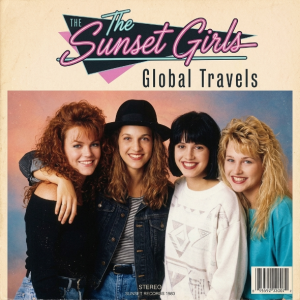
Key Singles (four songs reach the Billboard Hot 100)
- "Global Travels" (lead single)
The title track. Bright and anthemic, but less immediate than previous lead singles.
Peak: #28
- "American Girls"
The smash. Written on the road, it is about young women traveling the world, missing the United States, and still feeling proud of the country they come from. Full of restless energy, big choruses, and open-hearted patriotism from a distinctly female, early-20s perspective.
Peak: #1 (their second and final chart-topper).
Becomes one of their most enduring songs and a minor 1980s cultural touchstone. - "Timothy"
Upbeat, song about a girl missing her boyfriend/fiance, which became a classic 80’s love ballad.
Peak: #15
- "Postcard from Paris"
Catchy mid-tempo single that keeps the album on the radio into the fall.
Peak: #22
By 1984 The Sunset Girls had become a genuine international act, scoring multiple hit singles, heavy MTV rotation, and sold-out shows in the United States, Europe, and Japan.
In early 1985 the band came to an abrupt end. Laura Ford was diagnosed with early-onset cancer of the vocal cords, strongly linked to years of smoking. The damage was severe enough that she could no longer sing or perform. The remaining members chose to disband rather than continue without her.
The experience permanently changed both sisters. Vicki, who had always hated smoking, and Laura, who paid the price for it, quit tobacco for good and never returned to it. The episode also shaped Vicki’s lifelong opposition to smoking marijuana, even as she later came to support legalization of cannabis in other (non-smoked) forms.
Victoria “Vicki” Ford Solo Career (1985–1992)
Following the breakup of The Sunset Girls in early 1985, Vicki initially had little interest in immediately returning to music. The sudden end of the band, coupled with her sister Laura’s cancer diagnosis, left her emotionally exhausted after nearly six years of constant recording, touring, and performing.
But by the summer of 1985, Vicki began writing songs again.
Unlike The Sunset Girls' bright California girl-group sound, her solo material leaned toward glossy pop, sophisticated pop-rock, and adult-oriented contemporary, while retaining the melodic hooks and harmonies that had made her famous. Her voice, once one part of a four-woman group, became the centerpiece.
She signed a solo record deal in late 1985 and began recording her first album.
Vicki Ford (March 1986)
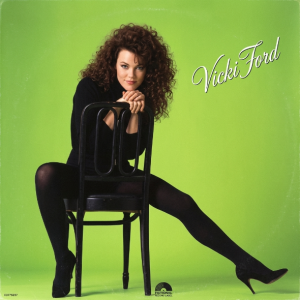
Vicki's self-titled debut established her as a legitimate solo star rather than simply "the former lead singer of The Sunset Girls."
The album retained some of the sunny California atmosphere of her previous work, but featured a more mature sound, with synthesizers, polished production, prominent guitars, and larger ballads.
The album became an immediate commercial success.
Billboard 200 peak: #5
Certified: 3× Platinum
Major Singles:
"Only a Dream"The lead single and Vicki's introduction as a solo artist. A bright, emotional pop song about realizing that a relationship has quietly fallen apart.
Peak: #3 on the Billboard Hot 100
It received heavy MTV rotation and proved that Vicki could carry a hit without The Sunset Girls.
"Heaven Knows"
A romantic, soaring pop ballad that became one of the album's defining songs.
Peak: #1
The song spent 2 weeks at #1 and became Vicki's first solo chart-topper.
"California Nights"
A breezy, nostalgic song about driving through Southern California at night. The song deliberately echoed the imagery of "Sunset Boulevard," giving longtime fans a connection between Vicki's group career and her new solo identity.
Peak: #8
"Runaway Heart"
An energetic fourth single that kept the album on the charts through the winter.
Peak: #17
By the end of 1986, Vicki had successfully established herself as one of America's major female pop stars. Rather than being remembered simply as the singer from The Sunset Girls, she was now a solo act in her own right.
California in My Heart (September 1987)
Vicki's second solo album represented her full transition into an established pop superstar.The production was bigger and more polished than her debut, embracing the increasingly sophisticated sound of late-1980s pop. The album dealt heavily with love, independence, growing older, and the complicated emotions of life after sudden fame.
Billboard 200 peak: #2
Certified: 4× Platinum
It became the biggest-selling album of her solo career.
Major Singles:
"I Want You Back"A bright, energetic pop song about refusing to give up on a relationship.
Peak: #1
It spent 3 weeks at #1 and became Vicki's second solo chart-topper.
"If You Were Mine"
A romantic mid-tempo song with a huge chorus.
Peak: #4
"Love Comes Around"
An upbeat pop-rock track that became particularly popular on MTV.
Peak: #7
"Somewhere Tonight"
A softer fourth single that showed Vicki's increasingly mature vocal style.
Peak: #14
The album turned Vicki into a genuine international superstar. She embarked on her first major solo world tour, performing throughout North America, Europe, Japan, and Australia.
By the end of 1988, she had largely established a reputation independent of The Sunset Girls.
Electric Heart (October 1989)
Vicki's third solo album arrived at the height of her popularity.The album embraced the polished, highly produced sound of the late 1980s, incorporating synthesizers, drum machines, electric guitars, and layered vocal production. It was more sophisticated and slightly more mature than her previous records.
Thematically, the album focused on relationships, independence, fame, and the feeling of trying to maintain a normal life while living in the public eye.
Billboard 200 peak: #1
Certified: 5× Platinum
It became Vicki's biggest solo album.
Major Singles:
"Electric Heart"The lead single and title track.
An enormous, energetic pop song about falling helplessly in love.
Peak: #1
Weeks at #1: 4
The song became one of the defining pop songs of 1989 and is widely regarded as Vicki's signature solo hit.
"After Midnight"
A darker, more atmospheric pop song about a complicated relationship.
Peak: #3
"Hold On to Me"
A powerful romantic ballad that became one of her most recognizable songs.
Peak: #2
"Dancing Alone"
A more upbeat fourth single released in early 1990.
Peak: #9
The success of Electric Heart cemented Vicki's position as an A-list international pop star. She received multiple award nominations, appeared regularly on television, and became a staple of MTV.
Hearts on Fire (June 1991)
By the early 1990s, Vicki was beginning to move away from the extremely polished sound of the previous decade.Hearts on Fire retained her pop sensibilities but incorporated more guitar-driven production and adult contemporary influences. The album felt less like an attempt to chase the latest pop trend and more like an established artist settling into her own style.
Billboard 200 peak: #4
Certified: 3× Platinum
Major Singles:
"Hearts on Fire"The lead single and title track.
A passionate pop-rock song about falling in love despite knowing the relationship could end badly.
Peak: #1
Weeks at #1: 2
It became Vicki's fourth and final #1 single of her solo career.
"Don't Walk Away"
A dramatic ballad that became one of her biggest songs with adult contemporary audiences.
Peak: #5
"Something About You"
A bright, romantic pop song that sounded like a deliberate callback to her 1980s material.
Peak: #11
"The Last Summer"
A nostalgic mid-tempo song released as the album's fourth single.
Peak: #23
The album was another major success, although its sales were somewhat lower than Electric Heart. By 1992, however, the musical landscape was changing rapidly, and the glossy pop sound that had dominated Vicki's career was beginning to give way to alternative rock, grunge, and a new generation of pop artists.
The Best of Vicki Ford (October 1992)
After seven years as a solo artist, Vicki released her first greatest-hits collection.The compilation included major hits from her solo career as well as a handful of remastered Sunset Girls songs.
It also included one new single:
"Where We Started"
A nostalgic song reflecting on her career, her sister, The Sunset Girls, and everything that had happened since 1979.
Peak: #18
The greatest-hits album became a major seller, eventually going 2× Platinum.
By the end of 1992, Vicki had accumulated:
- 4 #1 Billboard Hot 100 singles as a solo artist
- Multiple Top 10 singles
- Two #1 albums
- Several multi-platinum albums
- More than a decade of professional success
- A successful career spanning both a famous girl group and a major solo career
By the mid-1990s, she had transitioned into a more selective career, appearing on television, performing occasional concerts, and occasionally recording new music.
The Sunset Girls Reunion (2000–2004)
After more than fifteen years apart, The Sunset Girls began occasionally reuniting in the early 2000s. The four women had remained close friends over the years, and the growing nostalgia for 1980s music brought renewed interest in the group.While Vicki had continued to have a successful solo career, Laura, Leslie, and Christine had largely stepped away from the music industry. The group had no intention of returning to the constant touring and recording schedule of their younger years, but they enjoyed performing together again for special events, television appearances, and charity concerts.
Eventually, the four women decided to record together again for the first time since 1985.
Walking into the Sunset (June 2002)
The first Sunset Girls studio album in seventeen years.The album reflected the passage of time, with the group embracing a more mature sound while retaining the bright melodies, harmonies, and California-inspired songwriting that had defined their original career. Rather than attempting to recreate their early-1980s sound, the album focused on nostalgia, growing older, friendship, California, and looking back on the lives they had built.
The album itself, however, was largely considered mediocre. While longtime fans were happy to have new material from the group, the record received mixed reviews and failed to generate much excitement beyond the group's established fanbase.
Billboard 200 peak: #61
Despite the album's lackluster performance, one song completely broke away from the rest of the record.
Major Single:
"California Never Leaves"The album's second single, and the enormous surprise of the reunion.
The song was about how much California had changed since the women first formed The Sunset Girls in Orange in 1979. It reflected on the changing landscape, disappearing orange groves, expanding cities, crowded freeways, and the transformation of Los Angeles and Southern California over the previous two decades.
However, the song was ultimately optimistic, arguing that while California itself had changed, the spirit that made the state special was still alive.
The song also served as a metaphor for The Sunset Girls themselves. They had changed, California had changed, and the world had changed, but the spirit that brought four young women together in a garage in Orange, California, was still there.
Peak: #5 on the Billboard Hot 100
The success of "California Never Leaves" was an honest shock to everyone involved.
Nobody expected The Sunset Girls, who had not released a new studio album in seventeen years, to suddenly have another major hit. The song initially received only modest attention before steadily gaining momentum on radio and through renewed interest in the group's legacy.
It eventually broke into the Top 10, before climbing all the way to #5.
The accompanying music video contrasted modern California with archival footage of The Sunset Girls during their original career, showing the women returning to familiar locations from their youth and reflecting on how much their surroundings had changed.
The song became one of the biggest nostalgia hits of 2002 and introduced The Sunset Girls to a younger generation who had never experienced their original period of popularity.
Ironically, despite "California Never Leaves" becoming a major hit, none of the album's other songs made the Billboard Hot 100. The record quickly developed a reputation as an album where one song vastly overshadowed everything else.
"California Never Leaves" ultimately became far more famous than Walking into the Sunset itself, with the song eventually becoming regarded as one of the band's most enduring recordings.
Following the unexpected success, The Sunset Girls made several television appearances and performed a limited number of reunion concerts through 2004. However, they had no desire to turn the reunion into another full-time career.
The group would largely return to their separate lives afterward, occasionally appearing together for special events.
For The Sunset Girls, Walking into the Sunset was therefore less of a traditional comeback than a one-song miracle an otherwise unremarkable reunion album that somehow produced one of the group's biggest hits more than twenty years after they first became famous.
Political views and career
Ford was largely apolitical for most of her career in the music industry. Although she described herself as patriotic and maintained a strong attachment to California, she generally avoided partisan politics and did not publicly identify with either major political party.Republican affiliation
Ford became interested in politics during the 2003 California gubernatorial recall election, when Republican actor Arnold Schwarzenegger launched his campaign for governor. She was attracted to Schwarzenegger's emphasis on government reform, fiscal responsibility, bipartisanship, and his status as a political outsider. His campaign was a major influence on Ford's political views, and following his election as governor, she became a member of the Republican Party.Ford subsequently identified as a moderate Republican. She supported traditional Republican positions on fiscal responsibility, government efficiency, public safety, and national defense, while taking more socially moderate positions than many members of the party. In particular, Ford supported abortion rights and described herself as a pro-choice Republican.
For much of the 2000s and 2010s, Ford remained politically active primarily as a private citizen. She occasionally endorsed political candidates and commented on public policy, but did not seek elected office. She generally avoided becoming associated with either the Republican Party's conservative or liberal factions.
By the 2020s, Ford increasingly expressed concern about the direction of California politics. She criticized both major parties for what she viewed as excessive ideological polarization and argued that the state's problems, particularly housing affordability, government spending, infrastructure, and the cost of living, required practical rather than ideological solutions.
2026 congressional campaign
In 2026, Ford announced her candidacy for the Republican nomination for the U.S. House of Representatives in California's 23rd congressional district. She joined the Main Street Caucus, a Republican congressional group associated with the party's more moderate and pragmatic wing.Ford presented herself as a political outsider and emphasized her background as a musician, business owner, wife, and mother rather than as a career politician. Her campaign adopted a populist tone while maintaining socially moderate and fiscally conservative positions.
Her campaign platform focused on reducing government waste, addressing California's housing affordability crisis, improving infrastructure, supporting small businesses, maintaining public safety, protecting Social Security and Medicare, environmental conservation, and increasing government accountability. She also advocated greater bipartisanship and argued that members of Congress should be willing to work across party lines.
Although she remained a Republican, Ford continued to support abortion rights and other socially moderate positions. Her political philosophy was frequently characterized as a revival of Rockefeller Republicanism, combining fiscal conservatism and support for business with moderate positions on social issues and an emphasis on effective government.
At the same time, Ford incorporated elements of contemporary populism into her campaign, particularly her criticism of political elites and partisan polarization. She argued that California needed leaders focused on practical problems rather than ideological disputes.
Ford's campaign slogan was “Common Sense. California Values. Getting Things Done."
She frequently emphasized that she had never intended to become a politician and that her decision to run was motivated by her concerns about her home state. Her long career in music, beginning with The Sunset Girls in Orange County and continuing through her successful solo career, became a central part of her political biography.
Ford characterized her candidacy as an attempt to contribute to the state that had shaped her entire life. She described herself as a moderate Republican, pro-choice, and a political outsider, while maintaining that her primary political objective was to bring what she called "common sense" back into California government.
Personal Life
Marriage
In 1979, shortly after graduating from Orange High School, Vicki married her high school sweetheart, Lucas Scott, at the age of 18.Lucas had known Vicki long before she became famous and remained one of the most important people in her life throughout her music career. Unlike Vicki, however, Lucas had absolutely no interest in being part of the celebrity world.
He deliberately maintained a very private life and rarely appeared publicly alongside his wife. He never sought interviews, publicity, or attention because of Vicki's fame. Despite remaining almost completely outside of the public spotlight, Lucas supported Vicki's career 1000% from the beginning.
Vicki also chose to keep her maiden name professionally.
By the time she became a household name, "Victoria Ford" and later "Vicki Ford" had become recognizable names in the music industry. Rather than changing her professional identity, she continued using Ford after marriage.
Lucas completely respected the decision and never pressured her to change it.
Their marriage remained remarkably stable despite the pressures that came with Vicki's career, including touring, recording, international travel, and the constant attention that came with being a famous singer.
Vicki has frequently described Lucas as the person who kept her grounded throughout her years of fame.
Their relationship has remained strong for more than four decades.
Vicki is also friends with many other 80's singers, including Daryl Hall and John Oates. In the Mid 1980's they considered doing a collaboration, but this never worked out. She is also friends with the American Rock Band Heart, being friends with both Ann and Nancy Wilson.
She has been supportive of modern artists, being a fan of Katy Perry, and Lady Gaga. She also publicly supported the #FreeBrittney movement as well.
Family
Vicki remained extremely close with her family throughout her career.She maintained a particularly strong relationship with her older sister Laura, despite everything they experienced together with The Sunset Girls. Laura's illness and the subsequent breakup of the group ultimately brought the sisters even closer together.
Vicki also remained close with her younger brother, Donald "Don" Ford, despite the very different paths their lives took.
Her relationships with Leslie Matthew and Christine Hale also remained strong long after The Sunset Girls originally disbanded. Unlike many bands whose members eventually become estranged from one another, there was never a major falling-out within The Sunset Girls.
The group had ended because of Laura's illness, and everyone understood that.
For Vicki, the group was never something that had "failed." It was something four friends had chosen to end together because one of their own needed them.
Vicki and Lucas have one child, a daughter: Christine Scott who was born in 1990. Christine was named after Vicki's longtime friend and fellow Sunset Girls member, Christine "Crissy" Hale. Vicki was determined to give her daughter a childhood that was as normal as possible despite growing up with a famous mother. Christine largely stayed away from the entertainment industry and has maintained a private life.


