
Final Patriot vote descends into chaos as lawmakers repeatedly switch sides
Politics | Q1, 2026
WASHINGTON, D.C. – A conference committee agreement on the Patriot missile and Ukraine assistance package produced an unusually chaotic final round of voting on Capitol Hill, with House Republicans uniformly rejecting the compromise and several Democratic lawmakers changing their positions as leaders struggled to assemble enough support to send the legislation to President Liam Reeves (R-South Carolina).
The conference report on the Patriot Co-Production and Ukrainian Air Defense Industrial Partnership Act was drafted by Senate Majority Leader Catalina Vega (R-Florida) and signed off on by Senator J.C. Clark (D-New Jersey) and House Minority Leader Louie MacArthur (R-Georgia).
Yet the agreement apparently proved difficult for both parties to defend when the rank and file were forced to vote on it.
House Republicans voted unanimously against the conference report despite negotiators preserving MacArthur’s sweeping Buy American provisions, which require Patriot systems and associated manufacturing funded under the legislation to remain in the United States.
House Democrats provided the votes necessary to keep the measure alive, but their own voting was marked by switches and uncertainty as members reconsidered the final compromise.
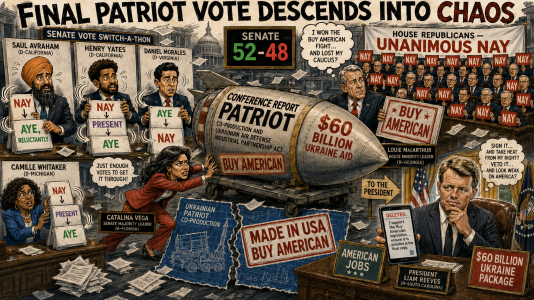
Representative Camile Whitaker (D-Michigan) voted against and present, before later switching her vote to being in favor before the vote finally closed.
The same spectacle played out in the Senate.
Sen. Saul Avraham (D-California), whose original legislation established licensed Patriot production in Ukraine without MacArthur’s provisions that have been seen by foreign policy experts as watering down the legislation considerably, initially voted against the conference agreement before changing his vote to a reluctant “Aye.”
“Helping Ukraine build the capacity to defend itself is a strategic investment in transatlantic security,” Avraham said at the time he originally introduced the legislation. “A stronger Ukrainian defence industry means a stronger NATO alliance, a more resilient democratic partner, and a clear message that aggression will not be rewarded.”
However, not everyone agreed with Avraham. Senator Eric Taylor (R-Texas) raised national security concerns about allowing missiles to be manufactured in the United States.
“I also have serious concerns about allowing Patriot missiles to be manufactured in Ukraine,” This is highly sensitive American military technology. We need to be careful about where our IP ends up.
Senate Majority Whip Henry Yates (D-California) changed positions twice, moving from “Nay” to “Present” before ultimately voting “Aye.”
Sen. Daniel Morales, meanwhile, moved in the opposite direction, initially voting for the agreement before switching to “Nay.”
However, the Senate ultimately adopted the report 52-48 and both chambers sent the report to the President’s desk by a total margin of seven votes across the two bodies.
The turmoil reflected the unusual coalition produced by the final agreement. The conference report retains $60 billion in broader security, economic and humanitarian assistance for Ukraine while also preserving House language requiring Patriot related production funded under the act to occur entirely in the United States.
That combination has alienated Republicans who oppose another major Ukraine package while leaving some Democrats uneasy that the Buy American provisions effectively eliminate the Ukrainian co-production program that gave Avraham’s original bill its name.
The result turned into the unusually public display of indecision over legislation already negotiated between the leadership in the two chambers.
Politically, the episode leaves few of the major players untouched.
For Vega, the narrow passage allows her to claim that she successfully assembled a coalition for a difficult conference agreement, but the messy voting also illustrates how little control either party’s leadership exercised over its members.
A conference report negotiated by senior figures in both parties ultimately survived not because either caucus embraced it, but because enough individual lawmakers decided that rejecting the entire package was worse than accepting provisions they disliked.
Democrats may face the most immediate questions about the visible vote switching.
Avraham ultimately supported a conference report that substantially curtailed the Ukrainian production program at the center of his original legislation, while Yates moved from opposition to neutrality and finally support during the same voting period.
Other Democrats moved in the opposite direction. The reversals provide opponents with an easy accusation that members were calculating the political or special interest consequences of their votes while the tally remained open rather than entering the vote with a settled position.
Republicans emerged with a different contradiction.
MacArthur successfully inserted some of the strongest Buy American language in the legislation, and organized labor had pressed lawmakers to preserve those provisions, yet House Republicans still rejected the final agreement en masse.
Their opposition underscored that, for much of the Republican conference, domestic manufacturing concessions were not enough to overcome objections to another $60 billion Ukraine package.
“This was one of those bills where almost everybody could find something they liked and something they absolutely hated,” political analyst Rosanne Huffman said. “Democrats who wanted Ukraine to build its own defense industry were being asked to accept language that effectively prevents that. Republicans who wanted Buy American protections got virtually everything they asked for on manufacturing, but still had to swallow another $60 billion for Ukraine.”
The narrow margins also complicate the politics for Reeves.
The President had previously signaled support for preserving the Buy American provisions before deleting the statement, and the conference report now arriving at his desk contains precisely those protections alongside a large Ukraine assistance package that has divided his own party.
Signing it would allow the White House to emphasize American manufacturing and replenishment of domestic weapons inventories, but opponents on the populist right are likely to focus instead on the tens of billions of dollars still committed to Ukraine.
For all the maneuvering, analysts said the final vote may ultimately be remembered less as a victory for either party than as evidence of how thoroughly the legislation scrambled the usual political alliances surrounding Ukraine.
“This bill passed, but almost nobody really won,” Huffman said. “Avraham lost much of the policy he originally wanted, MacArthur won his Buy American language but lost his own House Republicans, Democrats were changing votes in real time, and Reeves is getting a bill that divides the coalition that elected him. What Congress produced was not consensus. It was 218 votes here and 52 votes there from lawmakers who had very different reasons for deciding they could live with the same piece of paper.”

