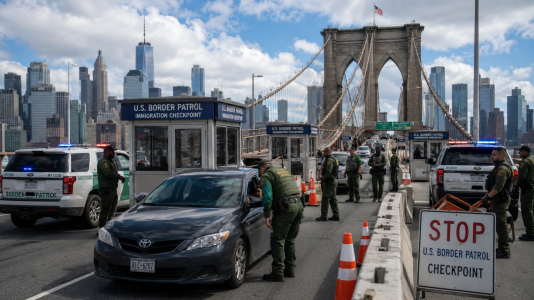
NEW YORK CITY — Today, the full 2nd Circuit agreed to rehear State of New York, et al. v. Titus en banc, giving the administration of President Liam Reeves (R-South Carolina) another opportunity to challenge a divided ruling that restricted how federal immigration checkpoints may be used for broader law enforcement purposes.
The court’s active judges voted 8-5 to grant rehearing, setting aside the ordinary three judge panel process and placing the dispute before the full circuit. That decision to rehear the case does not determine whether the court will ultimately uphold or reverse the earlier ruling though.
The original three judge panel from the circuit ruled 2-1 for New York. Judge Andrew Thyne, a Trump appointee and originalist, wrote the majority opinion joined by Biden-appointed progressive Judge Jennifer Droney. Trump-appointed Judge Joseph Parker dissented.
The panel held that the Department of Homeland Security (DHS) retained authority to operate lawful immigration checkpoints but could not use those checkpoints as a basis for generalized suspicionless criminal enforcement or continue detaining motorists after the legitimate immigration inquiry had ended without an independent legal justification.
The case arose from Operation NYC, a large-scale DHS immigration enforcement operation that established tactical checkpoints at bridges and tunnels throughout the New York metropolitan area. Border Patrol agents staffed the checkpoints, while the operational plan also contemplated K-9 units and portable equipment for testing suspected controlled substances.
Operation NYC had already ended by the time the panel decided the case.
That fact became one of the administration’s central arguments for rehearing. Attorney General Ashley Moody’s Justice Department argued that the case should not have produced prospective restrictions on future DHS operations after the specific operation being challenged had already concluded.
Parker made essentially the same argument in his dissent, contending that the federal courts lacked authority to regulate a completed operation based on the possibility that DHS might undertake something similar in the future.
The administration is also challenging the panel’s treatment of K-9 activity and secondary inspections.
The Department of Justice argues in their filing that Supreme Court precedent permits motorists to be referred to secondary inspection at immigration checkpoints without individualized suspicion and generally does not treat a canine sniff around a vehicle as a Fourth Amendment search.
The government maintains that the panel’s opinion risked casting constitutional doubt on practices already permitted under United States v. Martinez-Fuerte, United States v. Place and Illinois v. Caballes.
New York’s victory, however, did not categorically prohibit either practice.
The panel’s central holding concerned the length and purpose of detention: once the legitimate immigration inquiry is completed, DHS cannot continue holding a traveler solely to pursue unrelated criminal investigation unless officers develop an independent legal basis to do so.
That distinction is likely to become a major issue before the full court.
The en banc vote also underscores that at least some judges who may not ultimately side with the administration believe the questions presented are important enough to warrant reconsideration by the entire circuit.
The case could determine how sharply the 2nd Circuit distinguishes between traditional immigration checkpoints and broader federal policing operations that use immigration enforcement as their initial justification.
For now, the panel’s ruling remains the central legal dispute, but rehearing gives the Justice Department an opportunity to seek a narrower rule concerning K-9 sniffs, secondary inspections and whether courts may impose prospective relief after a short-duration federal operation has already ended.
The eventual en banc decision will govern federal operations throughout New York, Connecticut and Vermont and could shape whether the case becomes a candidate for Supreme Court review.
