
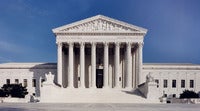
Supreme Court finishes term; rules on mifepristone and gun rights
Judicial | 2024
WASHINGTON, D.C. – Today, the Supreme Court finished a term that was certainly not as intense as 2021 (Dobbs) or 2022 (race based admissions), but one that still contained some impactful decisions.
In United States v. Rahimi, the Court upheld a provision enacted in the 1994 crime bill that bars anyone subject to a domestic-violence restraining order from possessing a gun.
The court upheld the provision 8-1, with Chief Justice John Roberts writing for the majority.
“Since the Founding, the Nation’s firearm laws have included regulations to stop individuals who threaten physical harm to others from misusing firearms,” Roberts wrote. “As applied to the facts here, Section 922(g)(8) fits within this tradition.”
Meanwhile, in Garland v. Cargill, the Court struck down the classification of bump stock devices as machine guns. A bump stock is a firearm accessory designed to facilitate the process of bump firing. Bump firing is the practice of using the recoil of a semiautomatic firearm to increase its rate of fire.
The federal government had argued that rifles equipped with bump stocks are machine guns, which are prohibited under federal law.
Justice Clarence Thomas wrote for the 6-3 majority that Congress could enact a law that would specifically ban all weapons capable of high rates of fire, but they had not. Therefore, the federal government was wrong to extend the ban on machine guns to include bump stocks.
“Congress did not write a statutory definition of ‘machinegun’ keyed to when a firing sequence begins and ends,” Thomas wrote.
In Food and Drug Administration v. Alliance for Hippocratic Medicine, the court ruled unanimously that the alliance had no standing to challenge the expansion of access to the drug mifepristone. Mifepristone is frequently used in medicated abortion.
That ruling ensures mifepristone will continue to remain widely available in the United States, where it is used in over 60% of abortions by health care providers.
The ruling does not shut down future challenges as states may have the standing to challenge those expansion efforts.
Finally, in National Rifle Association of America v. Vullo, the court ruled unanimously that the superintendent of the New York State Department of Financial Services had violated the NRA’s first amendment rights by encouraging banks and insurance agencies to cut ties with the organization.
“Vullo [the superintendent] was free to criticize the NRA and pursue the conceded violations of New York insurance law,” Justice Sonia Sotomayor wrote in the majority opinion. “She could not wield her power, however, to threaten enforcement actions against DFS-regulated entities in order to punish or suppress the NRA’s gun-promotion advocacy.”
While the full docket for the next term is still to be determined, the Court has signaled they will take up Free Speech Coalition, Inc. v. Paxton in their next term.
In 2023, the Texas legislature passed a law compelling websites to verify the ages of their users if more than one-third of their site’s content is “sexual material harmful to minors.”
The adult entertainment industry and civil liberties groups have argued that Texas’s requirement burdens access by adults to protected speech by requiring users to submit identifying information, such as a government-issued ID or commercially available age-verification data.
Texas, meanwhile, argues that the law is a child protection measure. The state maintains that websites selling or distributing sexual material should be able to confirm that their users are adults, much as retailers may verify a customer’s age before selling alcohol, tobacco, or other age-restricted products.
The Court will therefore be asked to determine whether the law is sufficiently tailored to protect children without placing an unconstitutional burden on adults’ ability to access lawful speech. The decision could have consequences far beyond Texas, as other states consider or enforce similar age-verification requirements for sexually explicit websites.
This term reflected a Court still willing to intervene in some of the country’s most contentious legal debates, even when its decisions did not produce the kind of sweeping doctrinal shifts seen in recent years.