
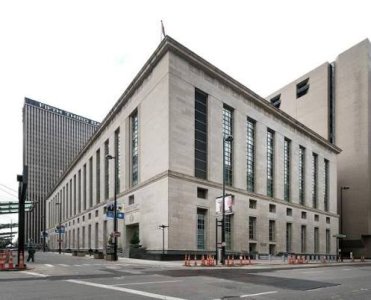
Sixth Circuit panel upholds Reeves affordability order, but says it cannot override federal customs law
Judicial | Q2, 2025
CINCINNATI, OHIO – A three judge panel of the 6th Circuit Court today rejected another challenge to President Liam Reeves’s (R-South Carolina) sweeping economic affordability executive order #10, concluding that the directive can remain in effect because it does not give federal agencies authority to disregard the customs laws enacted by Congress.
The panel ruled unanimously, 3-0, in Alliance for American Automotive Manufacturers v. Reeves. Chief Judge Sharon Deters, a George W. Bush appointee, wrote for the panel. Judges Chris Hanseman, an Obama appointee, and Charles Duhart, a Biden appointee, joined her opinion.
The Alliance for American Automotive Manufacturers represents automobile manufacturers and related businesses with operations across the country, including in Michigan, Ohio, Kentucky and Tennessee. Its members rely on the movement of parts and materials through commercial ports of entry as part of integrated North American supply chains.
The group said manufacturers experienced substantial freight delays following the implementation of two earlier Reeves directives, Executive Orders 0003 and 0005. According to the Alliance, those delays caused parts shortages, production slowdowns and shutdowns, higher transportation and storage costs and delayed vehicle deliveries.
The Alliance did not directly challenge either of those orders.
Instead, its lawsuit targeted portions of Executive Order 0010, which declared a National Economic Affordability Emergency and directed federal agencies to address supply chain disruptions and restore industrial production.
The Alliance argued that Congress, through the Tariff Act and other federal customs laws, had already established the system governing the inspection and processing of commercial cargo.
Although the President can administer and coordinate those programs, the Alliance maintained, he cannot create a separate customs system through executive action.
The panel agreed that Congress’ customs laws remain controlling but concluded that Executive Order 0010 does not purport to displace them.
“The Order repeatedly directs agencies to act within existing statutory authority, to the maximum extent permitted by law, and consistent with applicable law,” Deters wrote.
Those restrictions, the panel concluded, mean the executive order cannot itself provide authority for federal agencies to suspend or replace customs procedures required by Congress.
“The Court therefore holds that Executive Order 0010 remains valid, but does not authorize executive agencies to suspend, replace, or disregard the customs framework enacted by Congress,” Deters wrote.
The panel reached a similar conclusion regarding Reeves’ declaration of a National Economic Affordability Emergency. According to the court, the declaration does not independently expand presidential power over commercial trade.
“An emergency declaration may permit the Executive Branch to exercise powers Congress has otherwise provided, but it does not itself authorize the President to rewrite federal customs law,” the opinion stated.
The court also considered the administration’s subsequent Fast-Track Border Logistics Corridor for industrial and automotive freight. That initiative uses existing programs, including FAST lanes, the Customs-Trade Partnership Against Terrorism and the Automated Commercial Environment, to expedite qualifying commercial shipments.
The Alliance did not challenge the corridor insofar as it relies on authority already provided by Congress. The panel found that the record did not establish that Executive Order 0010 was currently being used to deny or materially alter commercial processing in violation of federal law.
The court distinguished that question from the earlier freight disruptions cited by the manufacturers, noting that those disruptions arose principally from Executive Orders 0003 and 0005, which are not before the court in this case.
The panel also left open the possibility of a later challenge to a specific agency action. If an agency relies on Executive Order 0010 as independent authority to take action inconsistent with federal customs statutes, the court said, an affected party may challenge that action.
Legal analyst Alexis Dunn said the decision fits a pattern emerging from the challenges to Reeves’s early executive orders, in which courts have been reluctant to strike down broad presidential directives before agencies take concrete steps beyond their statutory authority.
“The phrase doing an enormous amount of work for Reeves is ‘consistent with applicable law,’” Dunn said. “Again and again, these orders tell agencies to study something, make recommendations, coordinate policy, and/or act only within authority Congress has already given them. That makes the orders politically sweeping but legally much harder to attack. The courts are essentially saying: Come back when an agency actually does something unlawful.”
Dunn drew comparisons to the administration of former President Donald Trump (R-Florida) administration with this strategy.
“There’s a little bit of the first Trump administration in that dynamic,” Dunn said. “The rhetoric can sound much more revolutionary than the operative legal language. So far, Reeves has mostly avoided telling agencies, ‘Rewrite this regulation regardless of what Congress said.’ He has told them, ‘See what you can do, tell me what you recommend, and stay within existing law.’ That may be frustrating policy and it may be bad economics in the short run, but those are very different questions from whether the President has actually broken the law.”
The ruling leaves Executive Order 0010 and the Fast-Track Border Logistics Corridor in place.
The panel also emphasized that its decision does not insulate future agency actions from review. Manufacturers may bring a new challenge if federal officials rely on Executive Order 0010 to depart from customs procedures established by Congress.
The Alliance may seek rehearing before the full 6th Circuit or petition the Supreme Court to review the panel’s decision.